
The Model Context Protocol (MCP) is revolutionizing how artificial intelligence systems process information. By enabling context-aware interactions, MCP promises to enhance decision-making, comprehension, and communication between models and users alike.
Defining the Model Context Protocol

The Model Context Protocol (MCP) serves as a revolutionary framework, facilitating a nuanced understanding of context in artificial intelligence systems. At its core, MCP is designed to enhance the interpretative capabilities of AI models by structuring how they harness and react to contextual cues. This involves a systematic approach to managing data inputs to maximize relevance and accuracy in output generation.
MCP constitutes several foundational elements that forge its backbone. Primarily, it integrates context identification, which involves recognizing pertinent data segments that inform decision-making processes. By determining what constitutes valuable information, MCP helps AI models filter signal from noise, ensuring that only contextually relevant details guide their operation.
Another critical component of MCP is context adaptation. Unlike static algorithms, which follow pre-defined pathways, an MCP-driven model dynamically adjusts its inference mechanisms. This adaptability empowers models to remain responsive to evolving contextual parameters, enhancing their resilience and versatility across diverse scenarios.
MCP also incorporates memory utilization principles, whereby historical data interplay with real-time inputs. This capacity to draw from past interactions enables models to refine their understanding over time, akin to human learning. Such a mechanism vastly improves the predictive accuracy of AI systems, facilitating more coherent and contextually attuned outputs.
Furthermore, MCP emphasizes context prioritization, a method for ranking contextual elements based on their impact on outcomes. This hierarchy ensures that models focus on critical factors while processing information, thereby optimizing computational efficiency and result precision.
The significance of MCP in the AI ecosystem is profound, as it addresses a long-standing challenge—contextual mismatches. By instituting a robust protocol for context management, MCP not only improves interaction quality but also broadens the applicability of AI technologies. This capability is particularly pertinent for applications that demand context sensitivity, such as language processing and multimedia content creation.
For those interested in exploring practical AI applications, check out how to create AI art from text. This highlights how contextual understanding influences creative AI processes, underscoring MCP’s potential.
Thus, through its structured approach, MCP redefines how AI systems perceive, process, and prioritize context, fostering a deeper synergy between technology and human-like understanding.
The Mechanisms of Contextual Understanding
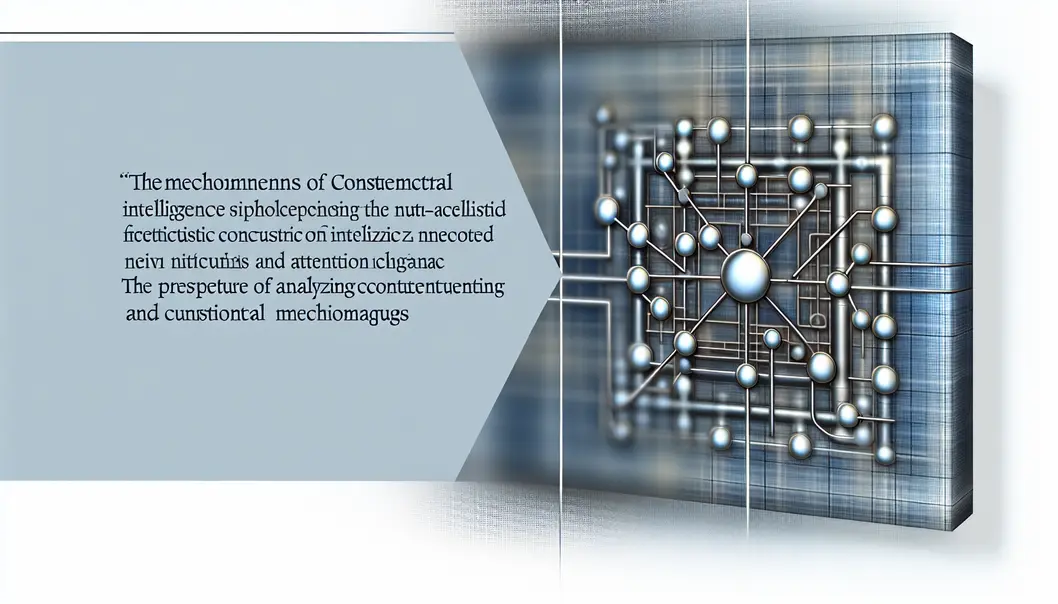
The Model Context Protocol (MCP) facilitates contextual understanding in AI by leveraging several sophisticated techniques. These techniques, integral to GPT models and beyond, enhance machine interactions with natural language, ensuring responses are grounded in rich contexts. Key among these techniques are attention mechanisms, context vectors, and embedding spaces—all vital for transforming raw inputs into meaningful outputs.
Attention mechanisms serve as the backbone of modern natural language processing. By allowing models to focus on specific parts of the input data selectively, attention mechanisms improve interpretative accuracy. Instead of processing input data uniformly, these mechanisms enable the model to weigh certain words or phrases depending on their relevance to the task. For instance, in a sentence with multiple subjects or objects, attention systems prioritize contextually significant components, ensuring coherent understanding.
Complementing attention mechanisms are context vectors. These vectors capture the essence of surrounding text to provide an enhanced semantic framework. As a deep representation of discourse, context vectors encode surrounding information, accounting for both sequential data and broader themes. Context vectors allow the model to maintain conversational relevance when generating responses, ensuring previous interactions influence subsequent outputs effectively.
Embedding spaces also play a crucial role by transforming words into continuous vector representations. Through embeddings, words with similar meanings or roles in different contexts achieve proximity in a multi-dimensional space. This spatial representation empowers models to seize cultural and linguistic nuances that numerical values might miss. By embedding words this way, MCP bolsters its capacity to recognize and interpret subtle variations in language usage.
These three components work in concert to enhance the flexibility and depth of AI language models. By integrating attention, context vectors, and embeddings, MCP not only elevates semantic understanding but also fosters natural-sounding interactions. By diving into such mechanisms, AI can adeptly generate content that resonates with human expressions and expectations. For those interested in practical applications of these technologies, resources on AI chatbots can illuminate how these elements work together in real-time interactions, such as in generating and scripting engaging text-to-speech outputs, as discussed in the AI-generated art domain.
Applications and Future Perspectives of MCP

The Model Context Protocol (MCP) is revolutionizing how AI systems understand and process information. Its relevance spans several applications, including virtual assistants, chatbots, and recommendation engines. By enabling AI systems to grasp the intricacies of context, MCP significantly enhances their efficiency and effectiveness.
In virtual assistants, MCP aids in deciphering complex user queries, providing more accurate and relevant responses. This advanced contextual understanding allows AI to discern user intent beyond keywords. Consequently, virtual assistants can offer solutions aligned more closely with user expectations, enhancing user satisfaction and engagement. For chatbots, MCP transforms them from being mere response generators to sophisticated conversational partners. Chatbots, powered by MCP, can maintain context over extended interactions. This results in a more natural and coherent dialogue flow, resembling human-like conversations without reliance on predefined scripts.
Recommendation engines also benefit immensely from MCP, which personalizes user suggestions. By analyzing user behavior and preferences in conjunction with contextual data, these engines offer highly relevant recommendations. This context-aware approach elevates user experiences on platforms offering content, products, or services designed to their current needs and desires.
While the current applications of MCP showcase its potential, future advancements promise to deepen its impact. In education, MCP could tailor learning experiences by adapting to each student’s learning pace and style. In healthcare, context-aware AI systems could provide personalized treatment plans based on context-derived insights.
Despite these promising applications, MCP faces challenges. One significant hurdle is the computational complexity required to process vast amounts of contextual data in real time. Addressing privacy concerns linked to collecting and analyzing sensitive user data is also crucial. Moreover, developing scalable MCP systems that integrate seamlessly across diverse platforms poses technical obstacles.
Future research and development in MCP will likely focus on overcoming these challenges. Innovations aimed at optimizing computational efficiency and enhancing data privacy can democratize MCP’s use across industries. Exploring these possibilities may usher a new era where AI systems can seamlessly integrate into everyday life, making tasks more intuitive and user-centric. For more insights into leveraging AI technologies, check out how to use AI chat platforms.
Final words
The Model Context Protocol is poised to redefine interaction paradigms in AI. By elevating the importance of context, MCP opens new avenues for richer, more intuitive machine learning and artificial intelligence experiences.